
Benefits of Ancestral Gut Support Supplements: What Evidence Shows
Quick Summary
Ancestral gut support supplements are products made from traditional fermented or organ-based foods, such as fermented potato, legumes and animal organs. Their benefits are not established for these products specifically: the strongest evidence concerns prebiotics in general, and the American Gastroenterological Association found probiotic evidence for digestive disease greatly lacking.
- Most of these supplements are made by fermenting a raw ingredient in water for days or weeks.
- Ancestral supplements can contain probiotics, prebiotics, or both, so the label matters.
- A 2026 review found prebiotic supplementation consistently increased beneficial bacteria, including Bifidobacterium.
- Organ supplements often list total organ weight without breaking out vitamin A content.
- Pregnant women face a lower vitamin A threshold because of birth-defect risk.
Table of Contents
- What Ancestral Gut Support Supplements Are and How They Are Made
- Potential Benefits of Ancestral Supplements for Gut Health and Digestion
- Do Ancestral Supplements Contain Digestive Enzymes?
- Beef Liver Benefits in Ancestral Supplements: What the Evidence Covers
- What the Research Says About Probiotics, Prebiotics and Gut Support
- Safety, Medication Interactions and Who Should Avoid These Supplements
- Choosing a Gut Support Supplement and Setting Realistic Expectations
- Frequently Asked Questions
What Ancestral Gut Support Supplements Are and How They Are Made
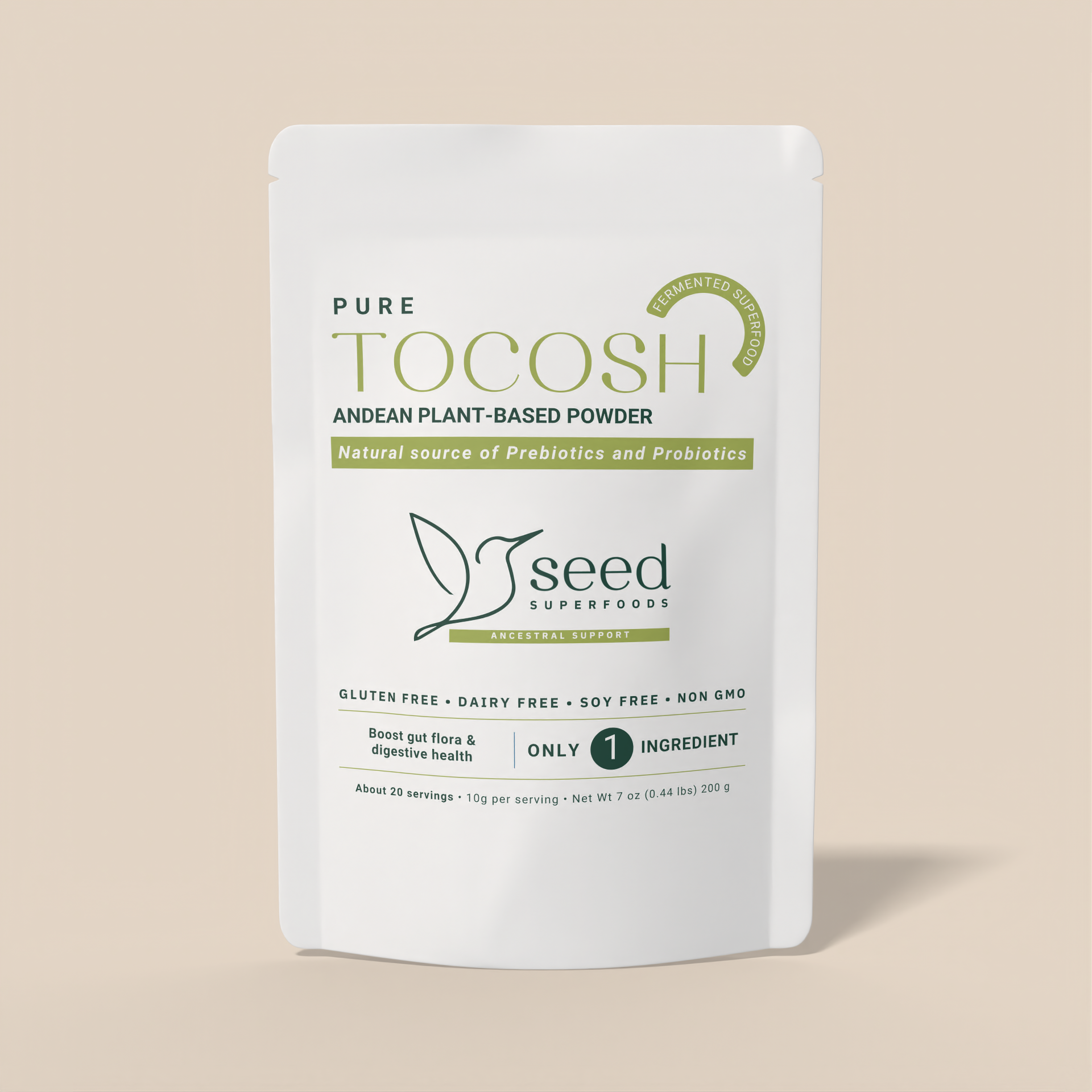
Ancestral gut support supplements are products built around traditional fermented or organ-based foods, most often fermented tubers, legumes and animal organs, prepared the way earlier cultures prepared them. Seed Foods sells one of these, a fermented potato product called Tocosh.
Most of these supplements are made by fermenting a raw ingredient in water for days or weeks, then drying or powdering the result. For a concrete example of this approach, see Tocosh Probiotic Superfood, which is made from fermented potato. The fermentation is what creates the live bacteria the category is known for, and it is also what makes product quality hard to judge from the label alone.
The Prebiotics and Gut Health review indexed by PubMed Central separates two categories that often get blended together: probiotics, which are live microorganisms, and prebiotics, which are the fibers that feed existing gut bacteria. Ancestral supplements can contain either, or both, so the label matters.
Our Tocosh Probiotic Superfood is priced at $28.99. It is one example of the category, not a template for every product in it.
Potential Benefits of Ancestral Supplements for Gut Health and Digestion
The strongest evidence in this area concerns prebiotics in general, not ancestral products in particular. A 2026 review reports that prebiotic supplementation consistently increased the abundance of beneficial bacteria, including Bifidobacterium, according to the review indexed by PubMed Central. That finding does not automatically transfer to a fermented food product.
Consumer interest is clearly rising. A 2026 consumer report from Nutrition Insight's gut health coverage says respondents most wanted to improve sleep (58%), maintain a healthy weight (50%) and improve digestive health (46%). The report does not state its sample size, so treat those figures as directional.
Do Ancestral Supplements Contain Digestive Enzymes?
Some do, but it depends on the product. Fermentation can produce enzymes as a byproduct, and some organ-based supplements contain enzymes naturally, but the amounts vary between batches and are rarely quantified on the label.
Digestive enzyme supplements are a separate category, usually made from plant or microbial sources and standardized by activity. An ancestral product is not a substitute for a standardized enzyme supplement, and buyers who need enzyme activity at a set dose should look for that dose on the label.
Beef Liver Benefits in Ancestral Supplements: What the Evidence Covers
Beef liver is one of the most nutrient-dense foods in the animal, and it is the ingredient most often used to justify organ-based gut support products. A 3-ounce serving of cooked beef liver supplies well over 100% of the Daily Value for vitamin A, roughly 70% of the Daily Value for vitamin B12, and meaningful amounts of iron, copper, riboflavin and folate, according to standard food composition data from the U.S. Department of Agriculture. Those are food-level figures, not supplement-level figures, and the difference matters.
The evidence problem is one of form and dose. Food composition tables tell you what is in liver; they do not tell you what survives drying, defatting and encapsulation, or how much of a nutrient a capsule delivers per serving. Most organ supplements list a total organ weight, often 500 mg to 3,000 mg per serving, without breaking out the vitamin or mineral content. That means a reader cannot compare a liver capsule to a liver meal on nutrient grounds, and any claim that a capsule "supports" a specific nutrient target should be treated as extrapolation from food data rather than demonstrated in the product itself.
There is also a ceiling to watch. Vitamin A is fat-soluble and accumulates in the liver, so a product that combines a high organ dose with a multivitamin or a diet already rich in liver can push total intake past the tolerable upper limit. The Institute of Medicine sets that limit at 3,000 micrograms of preformed vitamin A per day for adults; pregnant women face a lower threshold because of birth-defect risk. A common pattern is for labels to list liver weight but not vitamin A content, which makes it hard to know where a serving lands.
Sourcing and processing are the practical levers a buyer can actually check. Look for the species (beef, bison, lamb), the country or region of origin if stated, whether the animal was grass-fed and pasture-raised, and whether the label names a specific gland or organ rather than a generic "organ blend." Freeze-drying is the most common processing method because it preserves nutrients better than high-heat drying, but the label rarely says which method was used. Third-party contaminant testing, for heavy metals, especially in liver, which filters blood, is a meaningful quality signal when a brand publishes it.
The article's beef liver section turns on a few concrete figures and limits, which are easier to scan side by side.
| Item | Value | Note |
|---|---|---|
| Serving of cooked beef liver | 3 ounces | Food-level figure, not supplement-level |
| Vitamin A in 3 oz liver | Well over 100% of Daily Value | From USDA food composition data |
| Vitamin B12 in 3 oz liver | Roughly 70% of Daily Value | From USDA food composition data |
| Organ weight per supplement serving | 500 mg to 3,000 mg | Vitamin content often not listed |
| Adult preformed vitamin A limit | 3,000 micrograms per day | Institute of Medicine upper limit |
| Vitamin A threshold in pregnancy | Lower than adult limit | Birth-defect risk |
What the Research Says About Probiotics, Prebiotics and Gut Support
The evidence is more cautious than most marketing suggests. The American Gastroenterological Association's 2020 guideline found that evidence supporting probiotics for digestive diseases was greatly lacking, and it identified only three situations in which it made recommendations.
That does not mean probiotics do nothing. It means a general gut-support claim should be tested against the specific condition and the specific product.
Safety, Medication Interactions and Who Should Avoid These Supplements
That regulatory gap is the main reason this section matters: the burden of judging whether a product is appropriate falls on the buyer, and the categories below are where problems most often surface.
Histamine sensitivity. Fermented foods, including fermented tubers and many fermented vegetable products, can accumulate histamine and other biogenic amines during fermentation. People with histamine intolerance, mast cell activation issues, or a history of migraine triggered by aged or fermented foods may notice flushing, headache, hives or digestive upset after starting a fermented product. A trial-and-stop approach, a small serving for a few days, then reassess, is the usual way to check tolerability.
Immunosuppression and serious digestive disease. The same caution applies to anyone with active inflammatory bowel disease flares or recent gastrointestinal surgery.
Pregnancy and breastfeeding. Organ-based products can deliver preformed vitamin A, and high intakes of preformed vitamin A during pregnancy are associated with birth-defect risk. Fermented products are usually lower risk, but the combination of a prenatal vitamin, a diet rich in liver, and an organ supplement can stack. Pregnant or breastfeeding readers should have a clinician review the total vitamin A intake before adding an organ product.
Medication interactions. The interactions most worth flagging are not exotic. High-dose vitamin A can interact with retinoid medications such as isotretinoin, and the combination can push total vitamin A toward toxic levels. A pharmacist is the fastest route to a check on a specific medication list.
When to stop and seek care. Stop the product and contact a clinician for severe or persistent abdominal pain, bloody stools, vomiting, signs of an allergic reaction such as hives or swelling, or a new rash. These are uncommon, but they are the signals that separate a product that does not suit you from one that needs medical attention.
Watch out: "natural" and "food-based" are not safety claims, and a product that is fine for one person can be inappropriate for another based on medication, pregnancy status, or immune function, which is why the label and a clinician's review should come before the first serving, not after.
Choosing a Gut Support Supplement and Setting Realistic Expectations
Our Pure Tarwi Protein, at $39.99 for 1.1 lbs, is a plant protein rather than a fermented gut supplement. Readers comparing options can also review our anchor words guide to clean, plant-based protein. For readers whose main concern is digestive comfort with protein, our anchor words explains why some protein sources cause bloating, and our anchor words covers options for sensitive stomachs.

Frequently Asked Questions
Do ancestral supplements actually work for gut health?
The evidence is limited. Research on prebiotics, such as a 2026 PubMed Central review, shows they consistently increase beneficial bacteria including Bifidobacterium, but that review concerns prebiotics generally, not ancestral organ supplements specifically. The American Gastroenterological Association has also found evidence for probiotics in digestive disease greatly lacking. Ancestral supplements have not been tested in large, rigorous trials for gut outcomes, so benefits should be treated as unproven and individual responses will vary.
When should I take ancestral gut support supplements?
Talk with a clinician before combining any supplement with prescription medication, particularly if you have a chronic digestive condition.
Are beef organ supplements safe to take every day?
Pregnant people, people with liver conditions, and anyone taking medications should consult a healthcare professional first. Seed Foods' Tocosh Probiotic Superfood is priced at $28.99 for comparison.
Can digestive enzyme supplements help with digestion?
Discuss persistent symptoms with a doctor rather than relying on supplements alone.

Are Ancestral Probiotic Superfoods Good for Gut Health?
Best Vegan Protein Powder for Smoothies in 2026
Related Posts

Plant Protein Powder vs Whey: Which Fits Your Body

How to Work Ancestral Superfoods Into Your Daily Meals

Chocho Protein Amino Acid Profile: What the Numbers Show

7 Ways to Get Enough Protein on a Vegan Diet

Best Vegan Protein Powder for Smoothies in 2026

Are Ancestral Probiotic Superfoods Good for Gut Health?


