
How to Choose a Nut-Free Protein Bar Safely
Quick Summary
A nut-free protein bar is safe only if it was made in a facility that keeps nuts out, not just if nuts are missing from the ingredient list. Check the "Contains" statement, any advisory warnings, and whether the brand confirms in writing that it uses shared or dedicated equipment.
- Read the "Contains" line, which lists major allergens using common names.
- Scan the full ingredient list for hidden nut derivatives like almond flour or nut oils.
- Treat advisory statements such as "may contain tree nuts" as a sign of risk.
- Ask the manufacturer in writing whether the bar is made on shared or dedicated equipment.
- Note that "nut free" is not a regulated claim in the U.S., so confirm it directly.
Table of Contents
- Why Ingredient-Free Does Not Mean Allergen-Safe
- How to Read Food Labels for Allergens
- Checking Manufacturing Facilities and Cross-Contamination
- Finding the Best Protein for Sensitive Stomachs
- Avoiding Sugar Alcohols in Protein Bars
- Comparing Nutrition Markers: Protein, Sugar, and Fiber
- Booking Your Next Snack: Trying a Nut-Free Option Safely
- Frequently Asked Questions
Why Ingredient-Free Does Not Mean Allergen-Safe
Last Updated: November 4, 2026
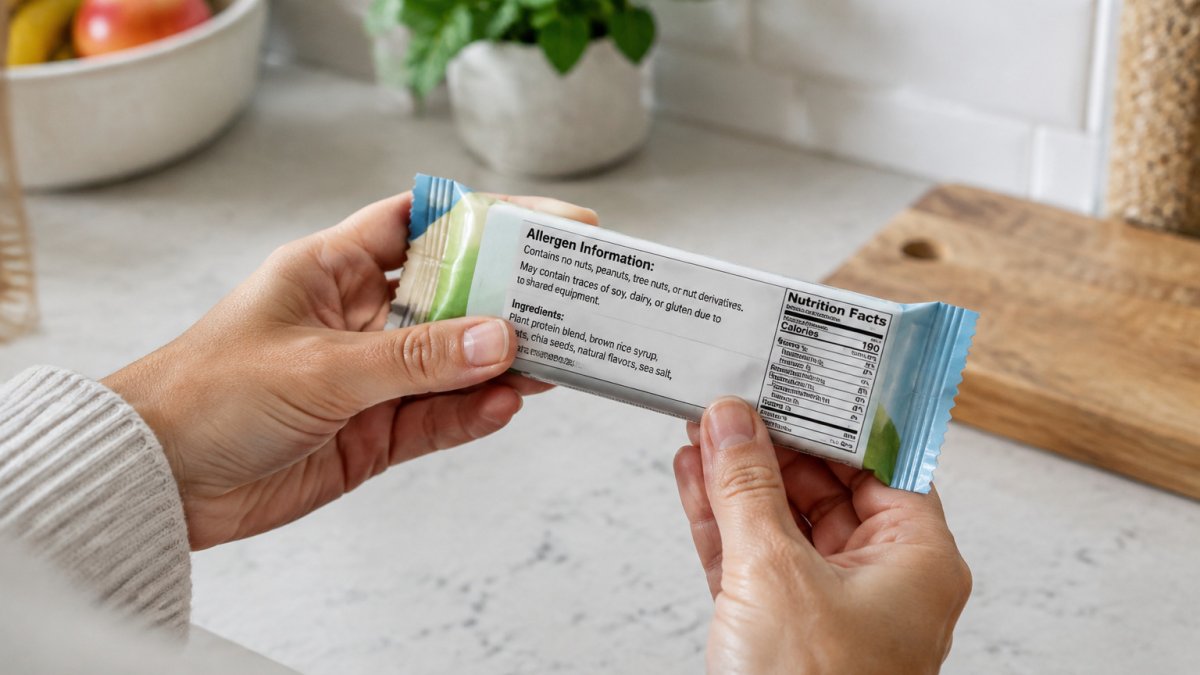
Many shoppers make the same mistake. They pick up a bar with no nuts in the ingredient list and assume it is safe for a nut allergy. That assumption can be dangerous. A nut-free protein bar is only safe if it was made in a way that keeps nuts out, and the ingredient list alone cannot tell you that. Many bars without nuts as an ingredient are still made on shared equipment, where trace amounts can end up in the product. For someone with a severe allergy, that small risk matters a lot. So when you choose a nut-free protein bar, read the allergen statement and any advisory warnings, not just the ingredients.
How to Read Food Labels for Allergens
Start with the "Contains" statement, which is the only allergen disclosure the FDA requires on packaged foods under the Food Allergen Labeling and Consumer Protection Act. That line must name any of the eight major allergens the bar includes, milk, eggs, fish, crustacean shellfish, tree nuts, peanuts, wheat, and soybeans, using the common name rather than a chemical name. If a bar contains almond butter, the "Contains" line should say "tree nuts (almond)," not just "almond butter" buried in the ingredient list.
Next, look for advisory statements: "may contain tree nuts," "made on shared equipment with peanuts," or "made in a facility that also processes tree nuts." These are voluntary under FDA rules, so their absence does not prove safety. A bar with no advisory statement may still be made on shared lines if the manufacturer chooses not to disclose it. Treat the advisory statement as a signal of risk, not a guarantee of safety when it is missing.
Then scan the full ingredient list, not just the front label. The front of the package is marketing; the ingredient list and allergen statement are the regulated facts. Watch for these hidden nut derivatives:
- Almond: almond flour, almond meal, almond butter, almond extract, marzipan, frangipane.
- Cashew: cashew butter, cashew milk powder, cashew flour.
- Pecan, walnut, hazelnut: nut oils (e.g., walnut oil, hazelnut oil), praline, gianduja, nougat.
- Coconut: coconut oil, coconut flour, coconut milk powder, the FDA classifies coconut as a tree nut, so it must appear in the "Contains" line if present.
- Shea nut: shea butter and shea oil are tree-nut derivatives that sometimes appear in chocolate coatings.
- Ambiguous terms: "natural flavors," "spices," and "vegetable oil" can hide nut-derived ingredients. A common pattern is that "natural flavors" may include nut-derived ingredients; the only way to know is to ask the manufacturer.
Watch out: a bar labeled "nut free" is not a regulated claim in the U.S., no federal standard defines what "nut free" means on a package, so the phrase alone tells you nothing about cross-contamination.
If the label is unclear, contact the brand directly and ask two questions: which allergens are present in the "Contains" line, and whether the product is made on shared equipment with tree nuts or peanuts. A brand that cannot answer both clearly is a brand to skip.
FDA Food Allergen Labeling and Consumer Protection Act guidance
Checking Manufacturing Facilities and Cross-Contamination
A bar can be made without nuts and still carry a risk if the factory also handles them. The label rarely tells you which scenario you are dealing with, so the real skill is vetting the manufacturer. Most articles stop at "look for a dedicated facility", here is how to actually verify it.
Understand the three facility tiers. A dedicated nut-free facility never allows nuts in the building, which removes cross-contact risk at the source. A shared facility with dedicated nut-free lines keeps nuts in the building but runs them on separate equipment with cleaning protocols between runs. A shared facility with shared lines runs nut and nut-free products on the same equipment, which is the highest-risk setup. Ask the brand which tier its bar comes from; the answer changes how much residual risk remains.
Ask the manufacturer these questions directly. Email or call customer service and request written answers:
- Is this product made in a facility that handles tree nuts or peanuts?
- Is it made on shared equipment, or on a dedicated nut-free line?
- What cleaning and allergen-control protocols run between production runs?
- Does the facility follow a documented allergen control program (often based on FDA's Food Safety Modernization Act preventive-controls requirements)?
- Can you provide the allergen statement in writing?
A brand that answers in specifics, naming the facility, the line, and the cleaning protocol, is showing you a real program. A brand that answers only with "trust us" or "our labels are accurate" is not.
Know what shared equipment actually means. Even a cleaned production line can leave trace residue in crevices, on conveyors, and in shared hoppers. For a person with a severe allergy, those traces can be enough to trigger a reaction. Dedicated facilities remove that risk at the source; shared facilities reduce but do not eliminate it. That is why the advisory statement "may contain" exists, it is the manufacturer telling you residual risk is present.
SUNFLOWER VANILLA PROTEIN BAR SNACK | HEALTHY SNACK | PLANT-BASED | 20G PROTEIN →
Check third-party certifications where they exist. Some facilities pursue independent audits for allergen control, and a brand that has done so can usually point to the certificate. Absence of a certificate is not proof of risk, but a brand that can name its audit is easier to trust than one that cannot.
Watch out: a "made in a nut-free facility" claim on a package is not verified by the FDA, so confirm it with the manufacturer in writing rather than relying on the front label.
FDA Food Safety Modernization Act preventive controls for allergens
Finding the Best Protein for Sensitive Stomachs
Many people with sensitive stomachs also need a nut-free option. Plant proteins can cause bloating for some people, so the protein source matters as much as the allergen profile. Our guide to why plant protein causes bloating explains the digestive causes behind this. Seed Foods uses chocho, an Andean lupin, as its protein base. Chocho is a plant protein with all nine essential amino acids.
Compare the protein sources in each bar, and pick one that sits well with your stomach. Our ALOHA alternative guide covers gentle, clean-label options that help prevent bloating. Try one bar at a time so you can tell what works for you.
Avoiding Sugar Alcohols in Protein Bars
Sugar alcohols such as erythritol, maltitol, and sorbitol keep bars low in sugar. They can also cause gas, bloating, and loose stools in some people. If you have a sensitive stomach, check the label for these ingredients and try a bar without them first.
Comparing Nutrition Markers: Protein, Sugar, and Fiber
A good snack bar is usually around 200 calories, with 10 to 15 grams of protein, low added sugar, and enough fiber to keep you full. Use those numbers to compare bars side by side.
- Protein: 10 to 15 grams for a snack-sized bar.
- Added sugar: The lower, the better.
- Fiber: Enough to help digestion and fullness.
Use these typical figures to compare bars side by side.
| Marker | Typical value | Note |
|---|---|---|
| Calories | About 200 | For a snack-sized bar |
| Protein | 10 to 15 grams | Check each label |
| Added sugar | As low as possible | The lower, the better |
| Fiber | Enough for fullness | Helps digestion |
Booking Your Next Snack: Trying a Nut-Free Option Safely
Ready to try one? Our SUNFLOWER VANILLA PROTEIN BAR SNACK | HEALTHY SNACK | PLANT-BASED | 20G PROTEIN | NUT FREE is made with chocho, gluten-free oats, honey, vanilla, and sunflower seed butter, and it costs $5.99. Start with one bar, see how you feel, and then decide if it fits your routine. If you want more options, browse our healthy on-the-go snacks to find something that works for your day.

Frequently Asked Questions
Which brands of protein bars are completely nut-free?
No protein bar can be guaranteed nut-free unless the label says so and the manufacturer uses dedicated nut-free facilities. Look for a clear allergen statement such as 'made in a dedicated nut-free facility' rather than relying only on the ingredient list. Experts advise choosing brands that avoid shared equipment, because shared lines carry a real risk of cross-contamination for people with severe allergies. Contact the manufacturer if the label is unclear before you buy.
How can I verify if a protein bar is truly nut-free?
Start by reading the full allergen statement, not just the ingredients list. Check for precautionary warnings like 'may contain tree nuts' or 'processed in a facility that handles peanuts.' If a bar lists no nuts but carries an advisory warning, treat it as unsafe for severe allergies. Contacting the brand directly to ask about dedicated nut-free production gives you the most reliable answer.
Are plant-based protein bars always nut-free?
No. Plant-based does not mean nut-free. Many plant-based bars use almond butter, cashew, or peanut butter as a binder, and some are made on shared equipment. You still need to read the label on every plant-based bar. Confirm the allergen statement on every product you buy, especially for children.
What ingredients should I avoid in nut-free protein bars?
Watch for nut butters (almond, cashew, peanut, hazelnut), nut flours, and nut oils, as well as derivatives such as marzipan or praline. Also be cautious with sugar alcohols if you have a sensitive stomach, since they can cause bloating and digestive discomfort. Shorter ingredient lists built on whole foods are generally easier to evaluate and tolerate.

Are Mineral-Rich Superfoods Worth Adding to Your Diet?
Are Mineral-Rich Superfoods Worth Adding to Your Diet?
Related Posts

Plant Protein Powder vs Whey: Which Fits Your Body

How to Work Ancestral Superfoods Into Your Daily Meals

Chocho Protein Amino Acid Profile: What the Numbers Show

7 Ways to Get Enough Protein on a Vegan Diet

Best Vegan Protein Powder for Smoothies in 2026

Benefits of Ancestral Gut Support Supplements: What Evidence Shows

Are Ancestral Probiotic Superfoods Good for Gut Health?


